Height in the Middle Ages, or How Tall Are You?
Determining height in the middle ages, and over time in general, is not easy, but we have some good data coming in of late that indicates the average height of people who lived in the 9-11th centuries in Britain was comparable to ours today. According to the report, “Mean Body Weight, Height, and Body Mass Index (BMI) 1960-2002: United States,” from the CDC (Center for Disease Control), the average height of a man aged 20-74 years increased from just over 5’ 8” in 1960 to 5’ 9 ½” in 2002. At the same time, the average height for women increased from slightly over 5’ 3” in 1960 to 5’ 4” in 2002. If you visit houses built in the 18th century, however, door frames were much lower than they are now. The obvious assumption, then, is that people were much Read more…
Literacy in the Middle Ages
What it means to be literate is not an absolute standard even now. This was even more true in the Middle Ages when the majority of the population couldn’t read at all, a certain percentage could read and not write, and the only way to be ‘literate’ at the time was if a person could read Latin. Literacy in other languages didn’t count. Wales, as always, went its own way. Taliesin, writing in the 6th century, wrote in Welsh. His is the first of a long tradition of Welsh literature–in the Welsh language–outside the control of the Roman Church. “The professionalism of the poetic tradition was sustained by a Guild of Poets, or Order of Bards, with its own “rule book” emphasizing the making of poetry as a craft. Under its rules poets undertook an apprenticeship of nine years to Read more…
Rushes on the Floor
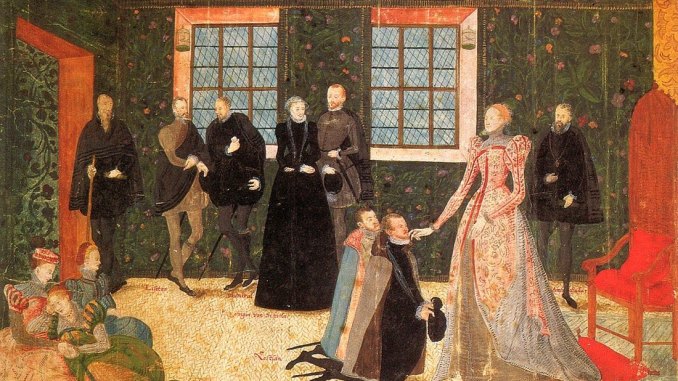
Everywhere in medieval life, you read about ‘rushes’ on the floor. I, too, have had an issue with the notion of women in long gowns, walking around on loose rushes, whether or not they were sprinkled with herbs. Wouldn’t it catch in the dress? This page has this to say, and started off my inquiry: “I was completely fascinated to find this page of notes about real life for the upper classes in the Middle Ages, and it addresses one of the things I’ve always wondered about. In fact, I came upon it while specifically searching for information about rushes as floor covering. In this piece, the author rejects the idea of loosely strewn straw-like rushes (in rich households), because of the impracticality of the ladies of the house, with their sweeping gowns, navigating such domestic terrain. She opines that what Read more…
The Welsh/British High Council
Within British (and by that I mean Welsh/Cymry/Celtic) legend, a High Council–a Parliament of a sort–existed in the Dark Ages to choose a “high king”. One of these high kings, according to legend, was King Arthur. Later, during Arthur’s reign, he instituted his ’round table’, a gathering of equals, to discuss the troubles in his realm. Or so the story goes. But did this High Council ever exist? The answer is ‘yes’–certainly during the reign of the last Prince of Wales, Llywelyn ap Gruffydd. In 1282 when Edward I of England wrote his letters to Llywelyn and Dafydd, demanding that they concede defeat, he also wrote a letter to the ‘Council of Wales’, laying out his case. To this they responded: “The people of Snowdonia for their part state that even if the prince desired to give the king seisin Read more…
Ten years ago today …
Ten years ago, on April 1, 2006, I wrote the first word of my first book. Sometimes it’s easy to pinpoint those moments in your life where everything changes. When you look across the room and say to yourself, I’m going to marry him. Or stare down at those two pink lines on the pregnancy test, when you’re only twenty-two and been married for a month and a half and are living on only $800 a month because you’re both still in school and my God how is this going to work? And sometimes it’s a bit harder to remember. Until I was eleven, my parents tell me they thought I was going to be a ‘hippy’. I wandered through the trees, swamp, and fields of our 2 ½ acre lot, making up poetry and songs and singing them to Read more…
Jews in Medieval England
Jews in Medieval England I’m updating this post, in large part because of a comment a reader left about my use of the word ‘pogrom’ in Footsteps in Time, having not heard the word before. A ‘pogrom’ is defined as: “An organized, often officially encouraged massacre or persecution of a minority group, especially one conducted against Jews.” http://www.thefreedictionary.com/Pogrom Jews lived in England during the Roman and Anglo-Saxon periods, but not as an organized community. This page states: “When William the Conqueror arrived in England in 1066, he encouraged Jewish merchants and artisans from northern France to move to England. The Jews came mostly from France with some from Germany, Italy and Spain, seeking prosperity and a haven from anti-Semitism. Serving as special representatives of the king, these Jews worked as moneylenders and coin dealers. Over the course of a generation, Read more…
The Last Pendragon Saga Updated!
Good news for readers of The Last Pendragon Saga: I will be adding to the series later this year (for the 12 of you who’ve read the series so far :). If you have read the series (published previously as The Last Pendragon/The Pendragon’s Quest) you can stop reading this post now. For anyone who has not tried the series yet (demons and sidhe mixing it up in dark age Wales, so beware) as with The Lion of Wales series of novellas, I’ve made it more accessible as bite-sized pieces, rather than the tomes they were before. Thus … six novellas! And new covers! 99 cents to start or FREE for those of you who subscribe to Kindle Unlimited. http://amzn.to/20zrqcB
East Oregonian Interview
I was interviewed for an article in the East Oregonian. An excerpt: “I don’t have a creative bone in my body,” she told a fellow Ph.D. student. In the years that followed, Woodbury proved herself wrong. The Pendleton woman has now written 21 medieval novels containing time travel, magic, treachery and adventure. The indie author has sold more than 400,000 books in the past five years. These days, one will likely find the mother of four at home typing on a computer, her 17-year-old cat, Luke, sprawled between the keyboard and the monitor. A poster near her desk proclaims, “Novelist at work. Bystanders may be written into the story.” Woodbury writes every day, at least 1,000 words. The result is a steady stream of books and a large cadre of devoted readers who eagerly await each new offering. Woodbury credits her Read more…
Footsteps in Time part of Storybundle deal!
THE HISTORICAL FICTION BUNDLE Curated by Charlotte E. English History is made up of stories, and those stories are vast, and varied beyond compare. The Historical Fiction bundle comprises a total of ten terrific titles by top-notch authors, together representing exactly this breadth and variety of experience. These stories blend real-world historical settings with romance, adventure, fantasy and mystery to bring you whole worlds of fun! You’ll visit ancient Egypt, the Americas, the Caribbean, Great Britain and Japan; you’ll meet pirates and warriors, witches and princesses, detectives, time-travellers and more. Lousia Locke offers a trip to Victorian San Francisco with her terrific Annie Fuller mystery novels. If you’re a subscriber to the StoryBundle newsletter, you’ll get the first title, Maids of Misfortune, for free! The second book, Uneasy Spirits,is part of our basic bundle, along with four other fantastic titles. Take a walk through Read more…
The Renegade Merchant
One of the best parts about writing historical fiction is reading about historical events and weaving them into the story. One of the worst things about writing historical events is having to adhere to what happened in history, especially when a beloved character dies. I had to include the death of a prince of Gwynedd, Rhun, in The Lost Brother, the prior book in the, and the death was as traumatic for me as for my readers. In the end of that year died Rhun, son of Owain, being the most praiseworthy young man of the British nation, whom his noble parents had honourably reared. For he was fair of form and aspect, kind in conversation, and affable to all; seen foremost in gifts; courteous among his family; high bearing among strangers, and fierce towards his enemies; entertaining to his Read more…
Medieval Diseases
In the Middle Ages, the range of types of diseases was similar to what we experience today, with some exceptions (HIV/AIDS). Viruses, of course, are no easier to combat now than then, but without vaccines and if the infected person was living in unclean or freezing conditions, or suffering from a poor diet, the disease was made that much worse. Antibiotics help with some diseases, but then again, more have sprung up in response to them (C-diff). That said, these are some of the most common diseases people experienced in Europe in the Middle Ages (not including the Black Plague, see: https://sarahwoodbury.com/?p=1000; or leprosy, see: https://sarahwoodbury.com/?p=223) Dysentary: Still common in poorer countries today, Dysentary is an infection caused either by bacteria or amoebas, spread through contamination of food and water by infected fecal matter. Typhoid is another such disease spread through bacteria and fecal matter which Read more…
Erase Me Not (The Paradisi Chronicles)
Announcement! I have written a book! I realize that isn’t news, but what is news is the book I’ve written, which I have told nobody about until today … A year ago, seven authors (including me) came together to write individual books set in a shared fictional world. We shared ideas, hammered out a backstory, drew maps, adapted technology, designed cities, and invented new species. Then we wrote stories about the people and places of this new world we’d created. We wrote in different styles, in different genres, and in different forms, In fact, we had so much fun that we have opened up this world to any other author who would like to write their own stories and add to the Paradisi Chronicles canon. (our FB page is here: https://www.facebook.com/paradisichronicles; our web page is here: http://www.paradisichronicles.com/) The Paradisi Chronicles: In the Read more…
^